
Should I Own a Dog If I Don’t Have Much Money?
This is a controversial question, and the answer depends on who you ask.
My answer is yes.
Anyone with love to give should be able to share their life with a pet, regardless of socioeconomic status.
Yesterday I helped an owner with an at-home euthanasia for her precious little dog. I arrived at an RV park and made my way to the back, where the spaces transitioned from full-time homes to camper trailers.
Her spot was number 43. The outside of the RV was cozy—door mats, yard decorations, a few plants. The inside was just as thoughtful: lace curtains, books neatly arranged, and her small dog, whom we’ll call Lucy, sitting on her lap in a fleece sweater.
Lucy had ongoing health issues that her owner could no longer afford to continue pursuing veterinary care for. Over time those issues began to affect Lucy’s quality of life, and her owner made the difficult, loving decision to let her go peacefully.
After Lucy passed, we sat together for a while and talked. I made my usual gentle suggestion—that someday she might consider another companion. Pets are so good for us in so many ways.
She shook her head.
She said she didn’t think that would be responsible of her given her financial situation. She was carrying a lot of guilt about not being able to afford more veterinary care for Lucy and felt that the responsible thing would be not to get another dog.
“Absolutely not,” I said, probably a little too quickly.
Everyone deserves pets, regardless of economic status.
If you have the love and time to give, I believe animals are one of the most powerful antidotes we have to loneliness and disconnection. They bring structure to our days, purpose to our routines, and companionship to lives that can sometimes feel very isolated.
I told her that I grew up poor.
Our pets rarely saw a veterinarian. Sometimes, before the monthly government assistance came in, they ate scraps until we could afford dog food again. But my bond with my beagle—Lady Dog—was profound. She was my seat of safety in an otherwise chaotic environment. She fed my soul.
Now, as an adult, I’m single and childless, and like many Americans I live a fairly independent life. My dogs are my companions. They get me out of the house to exercise when I might otherwise stay home. They provide unconditional love and connection.
I believe everyone deserves that.
The Reality of Veterinary Costs
That said, owning a pet on a limited or fixed income does come with trade-offs.
Veterinary care costs money. When medical problems arise, owners without financial resources may face difficult choices. Sometimes that means pursuing more limited treatment options. Sometimes it means needing assistance programs or payment plans. And sometimes—sadly—it means humane euthanasia when advanced care isn’t financially possible.
I often hear people say behind closed doors in veterinary clinics that if someone can’t afford veterinary care, they shouldn’t have a pet.
I respectfully disagree.
People with fewer financial resources can absolutely have pets. They simply must accept the reality that if their pet develops a medical problem requiring expensive care, they may not be able to pursue every available option.
In veterinary medicine we call this spectrum of care—meeting families where they are and tailoring treatment plans that work within their circumstances.
How Mobile Veterinary Medicine Changed My Perspective
This concept wasn’t really emphasized in veterinary training when I was in school. At the time, veterinary medicine was rapidly advancing, and “gold standard” or referral-level medicine was often the default recommendation. After graduation, I worked in referral and emergency hospitals where this type of medicine was the norm.
For a long time, I approached cases from that perspective.
I always had a soft spot for owners who couldn’t afford everything recommended, but I didn’t always know how to adjust treatment plans to meet their reality.
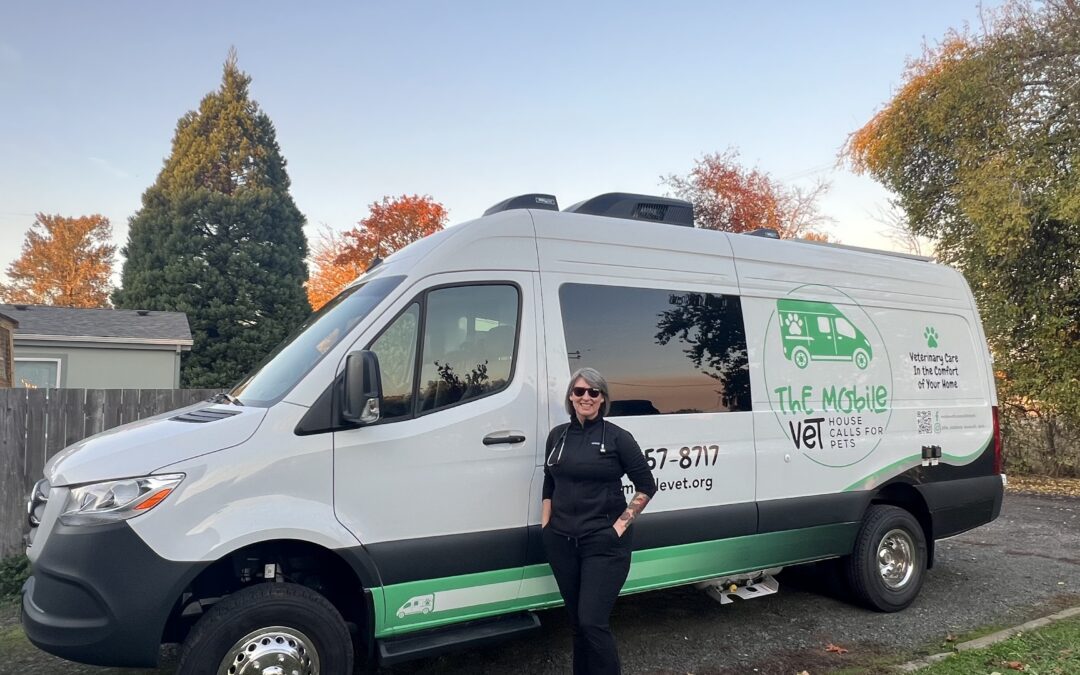
Becoming a mobile veterinarian changed that.
When you practice house-call medicine, you meet people where they live—literally. You sit on their living room floor beside them and their dog. You see their family photos, their books, their spaces. They stop being just another name on a schedule contributing to a long wait time in a busy hospital.
They become people again.
And when I think about someone like the woman in site #43, with her lace curtains and tiny RV home, doing the best she can for the dog she clearly loved with her whole heart, I cannot imagine telling her that she deserves less companionship than someone with more money.
Love, time, and devotion matter.
So while it may be an unpopular opinion in some corners of the veterinary “ivory tower,” I believe that anyone with love to give deserves the companionship of an animal.
And Lucy was very lucky to have had exactly that.
And I am honored to have been part of a plan that met Lucy and her owner exactly where they were.